
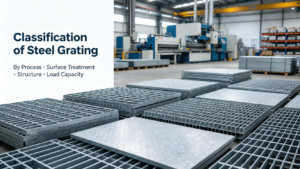
Steel grating is manufactured by welding flat bars and cross bars at regular intervals. It features high load‑bearing capacity, good ventilation, anti‑slip performance and easy installation & maintenance. It is widely used for platforms, walkways, stair treads, trench covers, power plants, chemical plants and municipal projects. Steel grating can be divided into different categories according to manufacturing process, surface treatment, structure and application scenarios, and each type fits different working conditions.
1. Classification by Manufacturing Process
Pressure‑welded Steel Grating
Flat bars and cross bars are joined by high‑pressure resistance welding. It has solid welding joints and high structural strength, which is the most popular type for industrial platforms, walkways and maintenance platforms.
Pressure‑locked (Interlocked) Steel Grating
Formed by stamping and interlocking without welding. Flat bars and cross bars are locked together. It has a smooth surface and nice appearance, suitable for projects with high aesthetic requirements, such as shopping malls, parks and municipal decorative platforms.
2. Classification by Surface Treatment
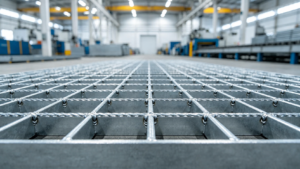
Hot‑dip Galvanized Steel Grating
The most common surface treatment. Hot‑dip zinc coating provides excellent anti‑rust and anti‑corrosion performance, long service life. Ideal for outdoor, humid and corrosive chemical environments. It is the first choice for industrial projects.
Electro‑galvanized Steel Grating
Thin zinc coating, limited anti‑rust performance. Mostly used for dry indoor environments with lower cost.
Painted Steel Grating
Surface painted with custom colors. Suitable for indoor decoration. Its anti‑corrosion performance is inferior to hot‑dip galvanizing.
Stainless Steel Grating
Made of 304 / 316 stainless steel. Excellent corrosion resistance for food, pharmaceutical, seawater and highly corrosive chemical environments. Higher cost.
3. Classification by Structure & Shape
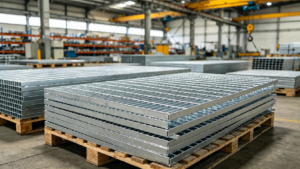
Standard Flat Steel Grating
Plain flat panel, most widely used for platforms, walkways and trench covers.
Serrated Anti‑slip Steel Grating
The flat bar edges are serrated. Great anti‑slip performance for wet, oily and slippery places, such as chemical workshops, car‑washing platforms and stair treads.
Composite Steel Grating
Combined with checkered plate on the base grating. It combines ventilation of grating and slip‑resistant closed surface, for partially‑closed platforms.
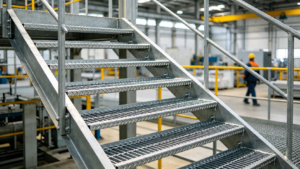
Steel Grating Stair Tread
Custom‑made stair treads with anti‑slip teeth, equipped with mounting clips for stair installation.
4. Classification by Load Capacity
Divided into light‑duty, medium‑duty and heavy‑duty grades by flat bar height, thickness and bar spacing.
– Light‑duty: For pedestrian walkways and light‑load passages
– Medium‑duty: General industrial platforms for personnel and light equipment
– Heavy‑duty: Can bear forklift and vehicle load, for truck passages and heavy‑equipment platforms
Conclusion
When selecting steel grating, you need to consider working environment, load requirement, anti‑corrosion demand and appearance. We support OEM & ODM customization. We can produce steel grating with different process, material and surface treatment according to your project requirements.