Performance Characteristics of Steel Grating
Steel grating is widely used for industrial platforms, walkways, stair treads, drainage covers, access flooring, and safety barriers. Its open-grid construction combines high strength with efficient drainage and ventilation, making it suitable for demanding industrial and commercial environments.
Understanding the performance characteristics of steel grating helps engineers, contractors, and purchasing teams select the right product for each project.
1. High Load-Bearing Capacity
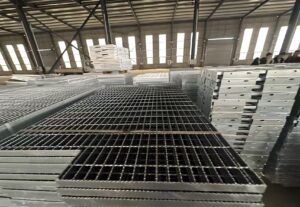
Steel grating provides excellent strength while using less material than a solid steel plate. Its bearing bars carry the primary load, while cross bars maintain spacing and improve structural stability.
Load-bearing performance depends on several factors:
- Bearing bar thickness and depth
- Distance between bearing bars
- Grating span
- Steel grade
- Concentrated and uniformly distributed loads
- Support and fixing method
Heavy-duty steel grating can be manufactured for areas exposed to forklifts, trucks, industrial machinery, and other high loads. The required load conditions and unsupported span should always be confirmed before production.
2. Excellent Drainage Performance
The open-grid design allows water, oil, mud, and other liquids to pass through quickly. This reduces water accumulation and helps keep working surfaces cleaner and safer.
Steel grating is commonly used in:
- Drainage channels
- Wastewater treatment facilities
- Car washes
- Food-processing plants
- Chemical plants
- Outdoor platforms
- Municipal drainage systems
The opening size can be adjusted according to drainage capacity, pedestrian safety, and debris-control requirements.
3. Slip Resistance
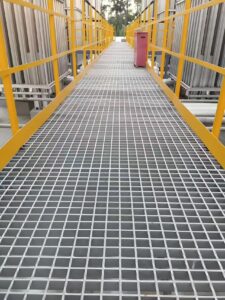
Standard steel grating provides reliable traction in many industrial environments. For wet, oily, snowy, or sloped areas, serrated bearing bars can provide additional slip resistance.
Serrated steel grating is particularly suitable for:
- Offshore platforms
- Factory walkways
- Loading areas
- Stair treads
- Wastewater facilities
- Outdoor access routes
The surface type should be selected according to actual site conditions and applicable safety requirements.
4. Corrosion Resistance
Steel grating can receive different surface treatments to improve corrosion resistance. Hot-dip galvanizing is one of the most common options because it forms a protective zinc coating over the steel surface.
Available material and surface options include:
- Untreated carbon steel
- Painted steel
- Hot-dip galvanized steel
- Stainless steel
- Aluminum grating
Hot-dip galvanized steel grating is suitable for most outdoor and industrial applications. Stainless steel is generally preferred in highly corrosive, hygienic, or chemical-processing environments.
5. Efficient Ventilation and Light Transmission
Unlike solid flooring, steel grating allows air and light to pass through its openings. This characteristic improves ventilation and can reduce the need for additional lighting below elevated platforms.
It is beneficial for:
- Multi-level industrial platforms
- Equipment maintenance areas
- Power plants
- Warehouses
- Cooling facilities
- Machinery access floors
Its open construction also prevents heat and fumes from becoming trapped beneath the walking surface.
6. High Strength-to-Weight Ratio
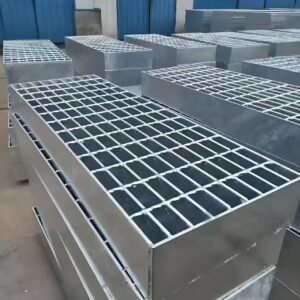
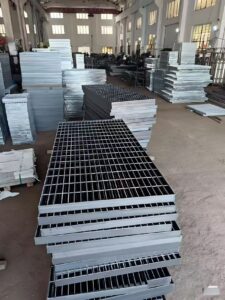
Steel grating offers high structural strength without the excessive weight of solid steel plate. Its relatively low weight makes transportation, lifting, and installation more efficient.
This can help:
- Reduce the load on supporting structures
- Simplify on-site handling
- Shorten installation time
- Lower transportation costs
- Make removable access panels easier to operate
The final weight depends on the bearing bar size, spacing, cross-bar arrangement, and panel dimensions.
7. Easy Installation and Maintenance
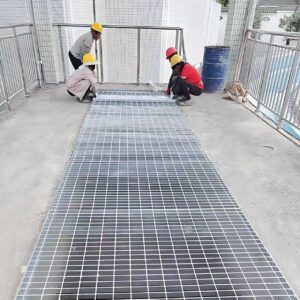
Steel grating panels can be manufactured to match the required dimensions, shapes, openings, and support conditions. They may be installed using clips, bolts, welding, or other fixing systems.
Removable fasteners are recommended where regular access to pipes, drains, valves, or equipment is required. Because dirt and liquids can fall through the openings, steel grating generally requires less surface cleaning than solid flooring.
Damaged or worn panels can also be replaced individually without removing the entire platform.
8. Flexible Customization
Steel grating is available in a wide range of configurations. It can be customized according to the project’s structural, safety, and installation requirements.
Common customization options include:
- Panel length and width
- Bearing bar dimensions
- Bearing bar spacing
- Cross-bar spacing
- Serrated or smooth surfaces
- Galvanized, painted, or untreated finishes
- Cutouts for pipes and equipment
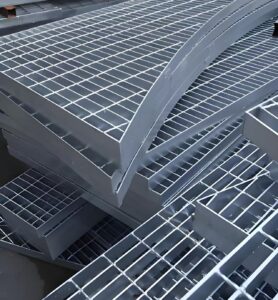
- Curved or irregular panel shapes
- Toe plates and edge banding
- Stair-tread nosing
Accurate drawings and load information help ensure that the finished grating fits the installation area correctly.
9. Long Service Life
When the correct material and surface treatment are selected, steel grating can provide a long service life under demanding conditions. Galvanized and stainless steel products offer especially strong resistance to weathering and corrosion.
Regular inspection should focus on:
- Loose or missing fasteners
- Damaged bearing bars
- Corrosion around cut edges
- Support condition
- Excessive deformation
- Obstructions affecting drainage
Proper installation and routine maintenance help extend service life and maintain safe performance.
How to Select the Right Steel Grating
Before ordering steel grating, confirm the following project information:
- Application and installation environment
- Required panel dimensions
- Clear span between supports
- Expected pedestrian, vehicle, or equipment loads
- Bearing bar size and spacing
- Surface and slip-resistance requirements
- Material and corrosion-protection method
- Cutouts, toe plates, nosing, or special shapes
- Applicable project standards
Conclusion
Steel grating combines high load-bearing capacity, efficient drainage, slip resistance, ventilation, durability, and installation flexibility. These characteristics make it a practical flooring and covering solution for industrial, commercial, and infrastructure projects.
The correct specification should always be based on the installation environment, support span, expected load, corrosion conditions, and applicable safety standards.