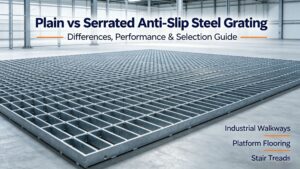
Steel grating is widely used for industrial walkways, platform flooring, drainage covers, stair treads and trench covers. Two of the most common types are plain steel grating and serrated anti-slip steel grating. Many buyers are confused about which one to choose for their projects. This guide clearly compares their structure, slip resistance, application scenarios and advantages to help you make the right purchasing decision.
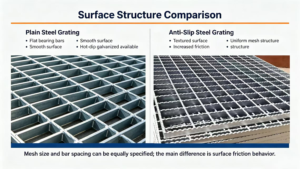
1. Definition & Surface Structure
Plain Steel Grating
Plain steel grating uses flat, smooth bearing bars without teeth on the surface. The flat steel remains straight and smooth after cutting and welding. The surface can be hot-dip galvanized for rust protection.
Serrated Anti-slip Steel Grating
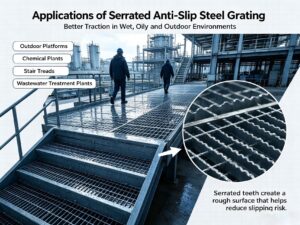
Serrated anti-slip steel grating is processed with notches (serrations) on the top edge of bearing bars. These continuous small teeth are stamped on the flat steel before welding. The serrated design creates a rough surface. It also supports hot-dip galvanized anti-corrosion treatment.
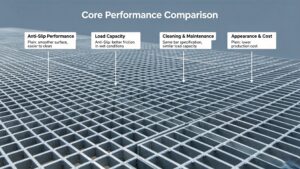
2. Core Performance Comparison
. Anti-slip performance
Plain steel grating: Smooth surface. Good for dry environments. When the surface gets wet, oily or dusty, slipping risk increases.
Serrated anti-slip steel grating: The serrated teeth increase friction greatly. Excellent anti-slip effect even on wet, oily, frosty surfaces.
. Load capacity
With identical thickness, height and pitch of bearing bars, both types have almost the same load-bearing capacity. The serration only changes surface shape and will not reduce overall structural strength.
. Cleaning & maintenance
Plain steel grating: Smooth surface, easy to sweep, rinse and remove debris. Less residue stuck on the surface.
Serrated anti-slip steel grating: The tooth grooves may trap small dirt and debris. Slightly harder to fully clean than plain type.
. Appearance & Cost
Plain steel grating: Clean, neat and smooth look. Lower production cost, competitive price.
Serrated anti-slip steel grating: Special stamping process adds manufacturing cost, so the unit price is slightly higher.
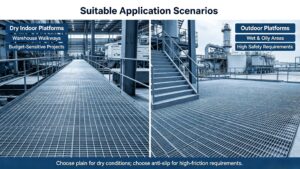
3. Suitable Application Scenarios
✅ Plain Steel Grating Recommended Use
• Dry indoor industrial platforms, warehouse walkways
• Drainage trench covers without oil or water splash
• Decorative grating, simple ventilation cover
• Projects with dry working conditions and budget-sensitive
✅ Serrated Anti-slip Steel GratingRecommended Use
• Outdoor platforms, chemical plants, oil & gas workshops
• Areas with frequent water splashing, oil residue, frost or rain
• Stair treads, offshore platforms, sewage treatment plants
• Places with high safety requirements to prevent slipping accidents
4. How to Choose Between Them
Choose plain steel grating if your working area stays dry, you prioritize easy cleaning and lower project cost.
Choose serrated anti-slip steel grating if the site is wet, oily, outdoor, or requires high safety standards for staff walking.
We are a professional steel grating manufacturer. We can customize plain steel grating and serrated anti-slip steel grating according to your size, load requirement and galvanized standard. Send us your drawings or specifications to get a quotation.
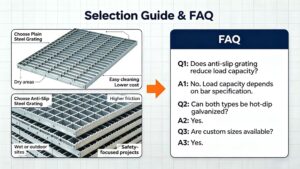
5. FAQ
Q1: Does serrated steel grating bear less weight than plain grating?
A1: No. Same bar specification means same load capacity. The serrated edge only improves anti-slip property.
Q2: Can both types be hot-dip galvanized?
A2: Yes. Both plain and serrated steel grating support hot-dip galvanizing for anti-corrosion.
Q3: Can you cut custom sizes for steel grating?
A3: Yes, custom cutting and fabrication are available.
plain vs serrated steel grating for industrial platforms
anti-slip serrated steel grating for walkways
plain steel grating for drainage covers