


Features of FRP Grating:
Resistant to acids, alkalis, and salt corrosion
Lightweight (density ≤2 kg/dm³) and high‑strength (stronger than aluminum and ordinary steel)
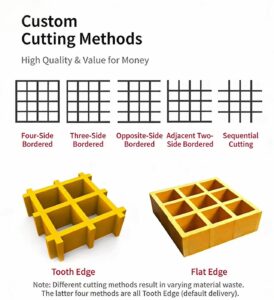
Easy to cut and install
Long service life (over 20 years)
Flame‑retardant (oxygen index ≥28)
Electrically insulating and slip‑resistant
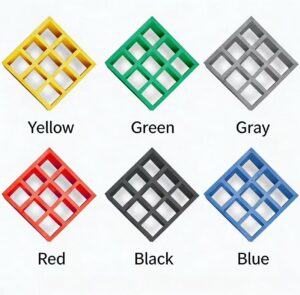
Customizable colors
Flexible design
Applications of FRP Grating:
Water treatment, chemical plants, oil platforms, textile mills, power plants, electroplating, marine and food industry, transportation, electronics, car washes, operating platforms, walkways, trench covers, stair treads, fences, boat decks, etc.
Precautions for FRP Grating:
Anti‑floatation design is required
On‑site repair requires strict curing conditions
Not detectable underground
Limited UV resistance
Manufacturing Processes of FRP Grating:
Reciprocating filament winding, continuous filament winding, and centrifugal casting.
How to Select FRP Grating:
Clarify the purpose → choose the thickness (e.g., 2.5 cm for car washes, 3.8 cm for wastewater applications) → determine the dimensions → select the resin type based on the corrosion level.
Installation Method of FRP Grating:
Manual installation. Keep the grating flat and taut, fix it with steel nails or stainless steel clips, ensure the overlap width meets requirements, and compact it by rolling.
Quality Identification of FRP Grating:
High‑quality products use premium resin, E‑glass fiber, and fine filler. They are free of cracks, have few voids, good gloss, and excellent strength and toughness. Low‑quality products show the opposite characteristics.